Act 1 Invitation
Before asking restaurants to trust VIVO, we spent a year trying to prove ourselves wrong.
We started with a simple delivery plan—and a question about what happens when that plan changes.
See how the question began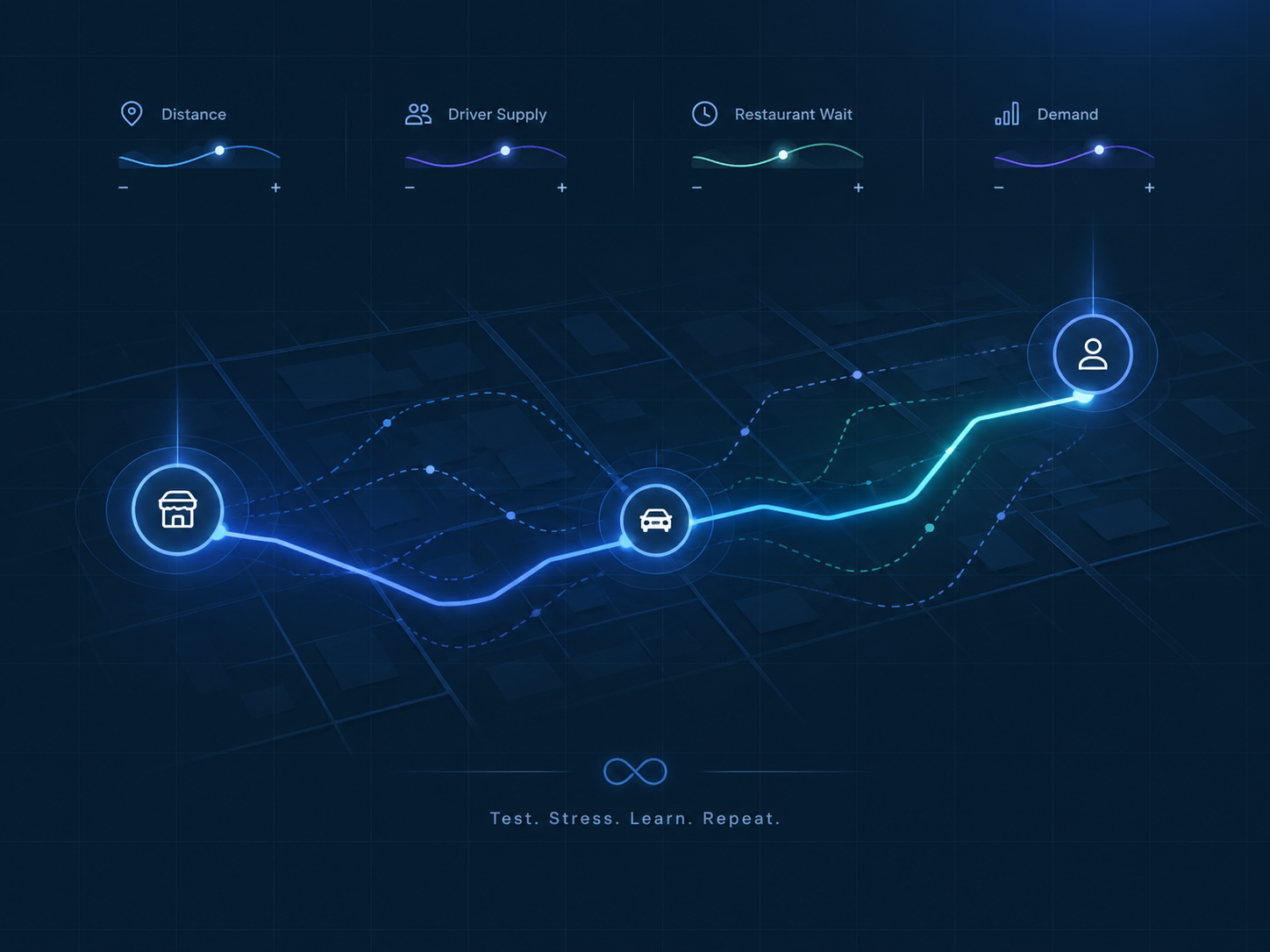
Act 2 One delivery, one question
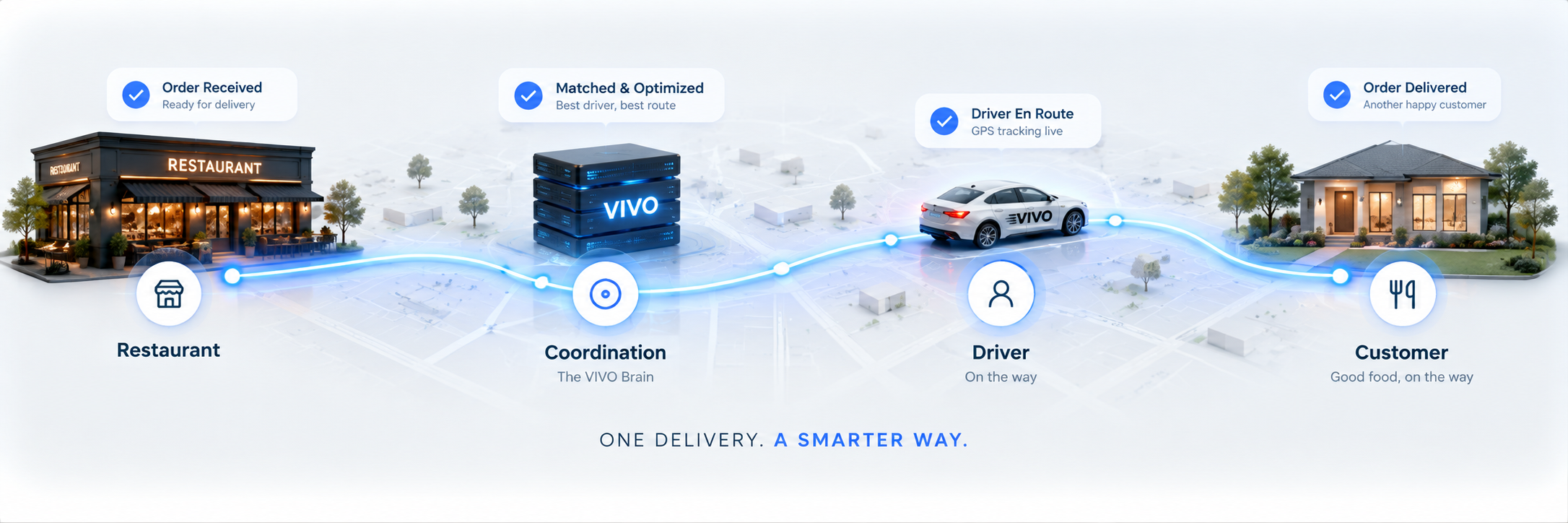
First, make the ordinary plan easy to see.
A delivery begins with a restaurant, coordination, a driver, and a customer connected by one intended route.
What if the plan changes?
Act 3 Signature adaptation moment
What happens when the driver disappears?
The system did not just follow a script. It responded when conditions changed in the synthetic/software-tested environment VIVO built and tested.
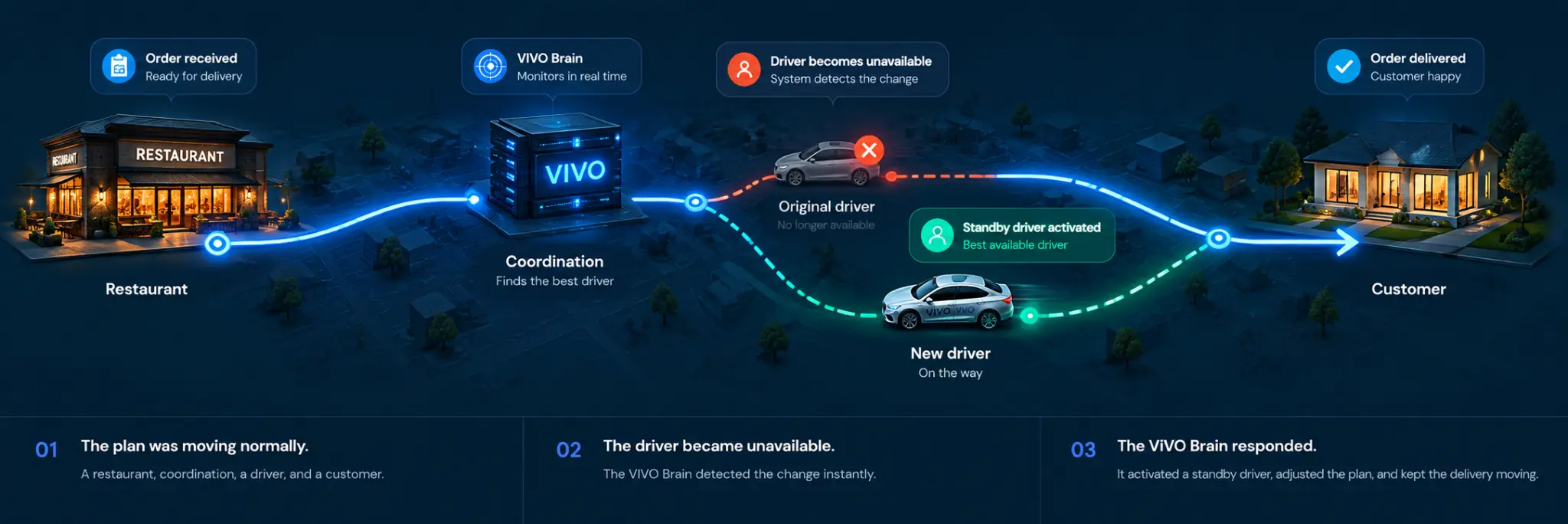
Plans change. The VIVO Brain responded under the conditions it was built and tested to handle.
Act 4 The work behind the moment
This wasn’t designed to look good on a webpage. It was designed to challenge the system.
VIVO built a synthetic testing program to challenge the delivery sequence, compare operating conditions, and examine the method used to evaluate the system.
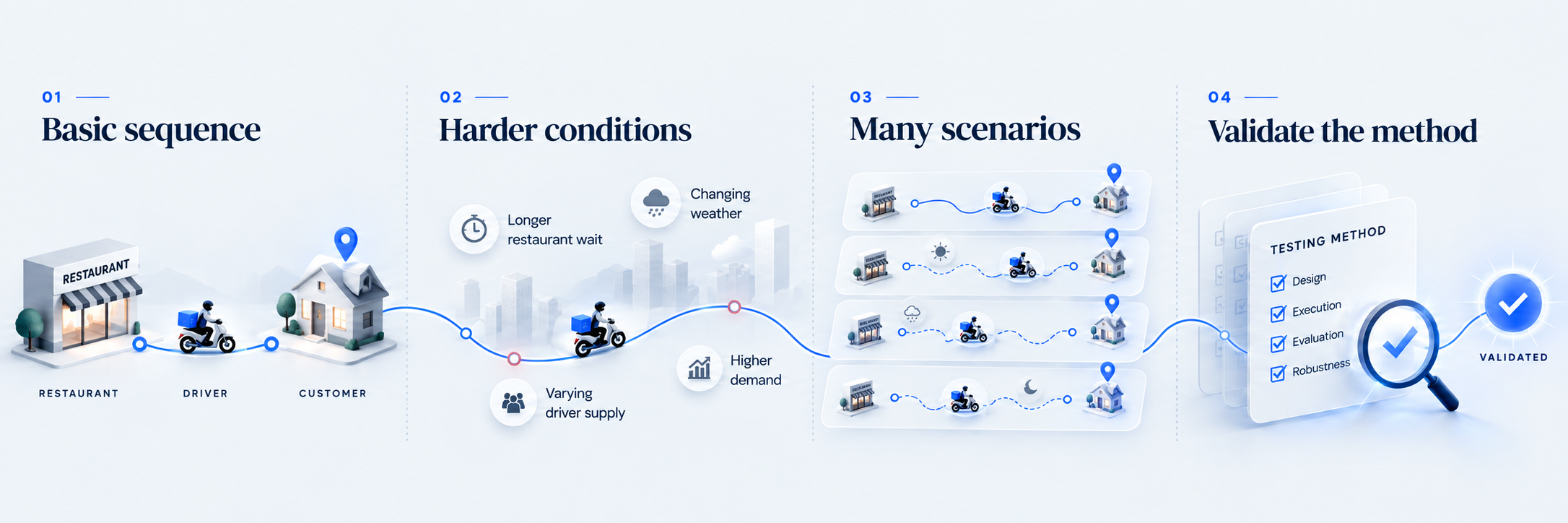
Campaign 10 is described publicly as large-scale operating validation.
Act 5 What emerged
Here is what the testing supported.
Only findings that have been verified against the governing record appear here. As the evidence base grows, VIVO will add findings one at a time—not fill space with weaker claims.
- 01
Verified finding
The VIVO Brain worked under the synthetic conditions tested.
Why it mattersThe test exercised the core dispatch and capacity logic as conditions changed, rather than evaluating a fixed, idealized route.
- Dispatch and capacity logic responded dynamically to changing conditions.
- Standby drivers activated when governed capacity required it.
- Intended pre-commitment safeguards were preserved.
- Every committed order completed across Campaign 10’s four simpler operating blocks.
- Evidence
- Synthetic Simulation
- Tested scope
- Campaign 10 · four simpler operating blocks
- Traceability
- Founder-verified Campaign 10 record
What this does not proveIt does not prove real-world field behavior, restaurant adoption, driver behavior, traffic performance, economics, or commercial viability.
Next validationField validation with restaurants, drivers, and real operating conditions.
Evidence boundary: This is a finding about synthetic conditions, not a claim of real-world or commercial proof.
Act 6 What surprised us
The testing changed some of our assumptions.
This chapter is reserved for verified moments when VIVO expected one thing and the evidence indicated another.
Evidence-backed surprises only
No surprise is being published before its prior expectation and observed result are verified.
The evidence showed diminishing returns after a point.
What we learned: geography and eligibility can matter as much as raw driver count.
The evidence showed restaurant wait could consume capacity quickly.
What we learned: restaurant readiness is part of delivery performance.
The evidence showed 5–7 miles still degraded even with additional drivers.
What we learned: distance creates structural pressure that extra drivers do not always remove.
Act 7 What remains open
The Brain worked in simulation. Now reality gets a vote.
We know how VIVO behaved in the synthetic environment we built and tested. The next step is to take those lessons to restaurant owners, challenge them against real operating conditions, and learn what holds up outside the model.
Synthetic Simulation
Controlled operating conditions
Evidence existsSoftware Validation
System behavior and workflows
Evidence existsField Validation
Real restaurant and driver workflows
Still aheadCommercial Validation
Sustainable real-world economics
Still aheadSynthetic simulation and software validation do not establish real restaurant fit, real driver behavior, field performance, real-world economics, or commercial viability.
The invitation forward